
Checking for a Warrant in Hall County
Hall County posts no public warrant search box. The county's real answer is routing: read the paper you hold, find the court named on it, and call that court first. Most people asking about a Hall County warrant are asking about their own case or a relative's. Those questions go to the court that set the date or signed the order. The sheriff's warrant deputies handle service instead. A jail catalog answers custody only. No Hall office promises a full warrant answer by phone, so ask what it can release. Before you call, write down the full legal name on the paper, the date of birth, the citation or case reference, and the court printed on the document. That saves a second call. Ask the office what step it wants next. Then get a lawyer's advice before you act.
- Read the citation, notice, or court paper and identify the court named on it.
- Call that court's clerk. Hall's traffic counter takes State Court citation questions at 770-531-7066, while a city court answers for its own cases.
- For an arrest warrant with no known source, call Hall Magistrate Court at 770-531-6912 or the Sheriff's Warrant Service Unit at 770-531-6907.
- Check custody separately, then treat the result as custody data rather than warrant status.
- Ask the right custodian for a defined record in writing when you need proof on paper.
Two official screens sit behind those calls. The county links a public Hall courts docket as a starting point for criminal and civil case entries, and its field labels should be checked on the live screen before anyone relies on them. Custody is separate. The Hall County inmate catalog shows who is in the jail at that moment. A blank result there says nothing about a Hall County warrant. A hit says nothing about why the person is held.
Why Hall County Has No Warrant List
Visitors expect a county warrant roster because so many records feel one click away. Hall County publishes none. The Sheriff's Warrant Service Unit page describes its mission, staffing, and phone number. It stops there. No names appear on it, no warrant numbers, no update schedule, and no status feed. Plan around that absence instead of filling it with a third-party index. Georgia works the same way at the state level. The Judicial Council's own ticket-locating instructions say plainly that no centralized statewide citation database exists, and they send the reader to the court on the citation. Criminal history systems used by police stay restricted to authorized law enforcement purposes, so they are no self-service lookup. GCIC sits behind that same wall. A member of the public cannot query it directly. One statewide partner site does offer arrest-warrant and ordinance searches, but its county menu covers a short list of participating counties, and Hall is not among them. What is left is the court file and the operational record, each held by a named office.
A Hall County warrant search is a sequence of official contacts, not one query. Each office keeps only its own papers, so each call answers one narrow question. The Hall County warrant lookup routes break the same channels down in more depth. Accuracy is the payoff. A court clerk can tell you what the docket shows today. A commercial index cannot. Work the calls in order, because the court that issued a warrant is the only place its current status can be confirmed.
Note: Treat any site that claims a complete and current Hall County warrant list as unverified, because no official Hall source publishes one.
Hall County Warrant Types
Four kinds of warrant move through Hall County most often, and each follows a different event. An arrest warrant follows a probable-cause finding. A bench warrant follows a missed court obligation. A search warrant authorizes a search, not an arrest. A probation or parole warrant follows an alleged violation of release terms. The Warrant Service Unit lists arrest warrants, arrest orders, probation and parole warrants, and bench warrants among the instruments it works. That is a useful map. Court records run through the Hall County Clerk of Superior and State Courts. Its Criminal Division and traffic counter serve as the practical record desks for adult cases. Arrest orders travel with that set. A probation warrant may originate with a supervising authority rather than the trial court. Georgia has no public statewide warrant index. The issuing court is the only reliable source for any one of them. Hall County warrant records live in the court file that created them.
| Warrant Type | How It Arises | Who Issues It |
|---|---|---|
| Arrest warrant | Sworn information establishes probable cause for an offense | Magistrate, State, Superior, or municipal judicial officer |
| Bench warrant | A required court date or citation deadline passes unanswered | The judge of the court that set the obligation |
| Search warrant | An investigative application seeks authority to search | Hall County Magistrate Court |
| Probation or parole warrant | An alleged violation of supervision terms is reported | The supervising court or state authority |
Felony matters sit with Superior Court. County misdemeanor and traffic matters sit with State Court. City ordinance and city traffic matters go to a municipal court. That hierarchy decides which Hall County warrant records a given clerk can see at all.
Which Hall County Court Issued the Warrant
Nine city courts and several county courts operate inside the same Hall County footprint, so jurisdiction comes first. The paper in your hand usually settles it. A citation prints both the court and the appearance date. So does a bond paper or probation notice, which names the case and the court that owns it. Guess wrong and you waste a trip, maybe sending a traffic defendant to the jail complex while a city clerk actually holds the file. Hall County's own traffic materials draw that line plainly. Four common routes follow from it, and each carries its own phone number.
- A citation naming Hall State Court goes to the Hall Traffic Violations Bureau at 770-531-7066 and the Clerk's counter.
- A citation naming Gainesville, Flowery Branch, Oakwood, or Braselton goes to that city's municipal court, even for a driver who lives elsewhere in Hall County.
- Paperwork tied to Lula starts at City Hall on 770-869-3801, because the city sits on the Hall and Banks county line and the court must be confirmed.
- An arrest warrant with no named court goes to Hall Magistrate Court or the Sheriff's warrant deputies.
The Hall County Traffic Division page lays out the State Court and municipal split, payment options, and the failure-to-appear consequence in one spot.
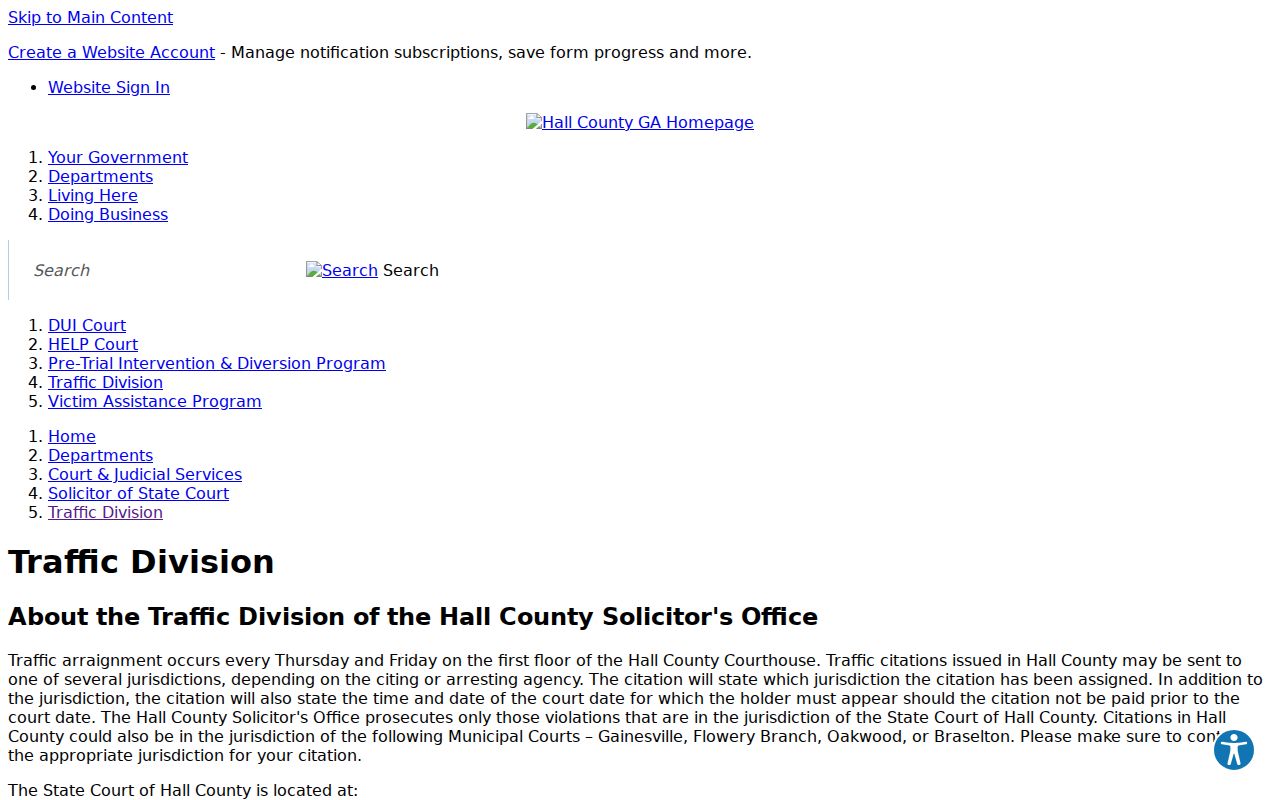
What matters here is the routing rule, not a lookup result. Hall County traffic arraignments run Thursdays and Fridays on the courthouse first floor. The counter takes cash, credit, debit, or money order, but not personal checks.
Inside a Hall County Warrant Record
A warrant file is really a set of fields, and no single Hall County record is guaranteed to carry all of them. Read each field on its own. The charge is not the outcome. The issue date is not the service date, and bond terms do not prove a case has ended. A failure-to-appear order adds a source custodian and a verification date, and so does the warrant file itself; those two fields decide how much weight the rest deserves. When a clerk answers, ask which fields the source system actually holds and what date the answer reflects.
| Warrant number | No Hall County public page exposes a warrant-number format, so a neutral stand-in such as masked court reference is safer than an invented pattern. |
|---|---|
| Issuing court | Magistrate, Superior, State, or a named municipal court, which controls who can answer. |
| Charge or offense | The statute cited and a short charge label as the record writes it. |
| Issue and return dates | Separate events for signing the warrant and for service or return. |
| Bond status | Bond set, no bond shown, released, or unknown, depending on the case posture. |
| Status as of a date | Issued, served, recalled, quashed, expired, or unknown, tied to a timestamp. |
A failure-to-appear record adds fields of its own: the missed appearance date, a coded reason, any driver-license notice, and whatever clearance instruction the court gives. The court keeps those, not the sheriff. Note: Always ask for warrant status as of a stated date, since a Hall County warrant can be served or recalled hours after a copy is printed.
Hall County Warrant Status Terms
Clerks and deputies lean on short status words that carry real legal weight. Mix them up and you can reach the wrong conclusion about a Hall County warrant fast. Six terms cover most of what a caller will hear. Each one points to a different next step.
- Issued
- A judge has signed the warrant and it has entered law enforcement systems for service.
- Served
- An officer has executed the warrant, so an arrest or booking event now exists in the file.
- Recalled
- The issuing judge has withdrawn the warrant, usually after the person answered the case.
- Quashed
- A court has set the warrant aside on legal grounds, which is not the same event as a recall.
- Failure to appear
- Often shortened to FTA, the missed court event that leads a judge to sign a bench warrant.
- Capias
- A word some Georgia papers use for a court's arrest writ. Hall County sources say bench warrant, and no Hall capias portal was found.
A Hall County clerk may not use every label a warrant document carries. When a term seems off, read the paper aloud and ask the court what it means by that wording.
Issuing and Serving Warrants in Hall County
Courts issue Hall County warrants. The Sheriff's Office serves them. Keeping those roles apart clears up most of the confusion callers bring. A judge decides whether probable cause supports a warrant, and only a judge can recall one. Deputies find people and execute the order, but they cannot rewrite the court's file. The Warrant Service Unit works out of the jail complex with a lieutenant, two sergeants, and eight deputies; its office staff file new and outstanding warrants and maintain law enforcement databases. Neither office speaks for the other. A caller who mixes them up usually gets sent back a step.
Warrant flow: sworn application › judge's probable-cause review › signed warrant › entry in law enforcement systems › service by deputies › court appearance, bond, or recall
Warrant Service Unit
1700 Barber Road
Gainesville, GA 30507
770-531-6907
Hall County Magistrate Court
225 Green Street, P.O. Box 1435
Gainesville, GA 30501
770-531-6912
Sheriff Records Supervisor
2859 Browns Bridge Road
Gainesville, GA 30504
770-531-6877
The unit shares the Barber Road complex with the county jail, whose main line is 770-531-6904. No public walk-in or surrender hours are published for warrant matters, so call before you drive. The official Hall County Warrant Service Unit page sets out the unit's role and its contact details.
That page is a program description, not a lookup. It carries an anonymous warrant tip form instead of a roster. The form routes information to deputies, and it is not a way to ask whether a warrant exists.
How a Hall County Warrant Application Works
An individual can ask a judge for an arrest warrant in Hall County, and the route runs through Magistrate Court rather than the Sheriff. That court handles applications, first appearances, and committal hearings, and it issues both arrest and search warrants. Applying is a court process with judicial review built in. Filing does not guarantee that a warrant will issue. The form itself records outcomes: a mediation hearing, a warrant hearing, a warrant issued, or no action at all. Hall County's published warrant application form shows exactly what the court expects an applicant to bring.
| Field Group | What the Application Asks For |
|---|---|
| Applicant | Date of application, name, address, and telephone number |
| Accused | Name, home and work address, age, race, sex, weight, height, hair, eyes, and date of birth |
| Incident | Crime date, location, and a brief factual description of the alleged offense |
| Witnesses | Two witnesses with addresses and telephone numbers |
| Court use | Mediation hearing, warrant hearing, warrant issued, no action, or other, plus a notes area |
| Access | Whether an interpreter is needed, and in which language |
Fees attach to the application. Hall County's current schedule lists a warrant and mediation application at $20, certified copies at $3, and regular copies at $0.25, revised July 1, 2024. The form cites O.C.G.A. §15-10-82 for the hearing fee, and because the form predates the schedule, confirm the amount by phone. The Hall County Magistrate Court page carries the application contact and the court's jurisdiction.
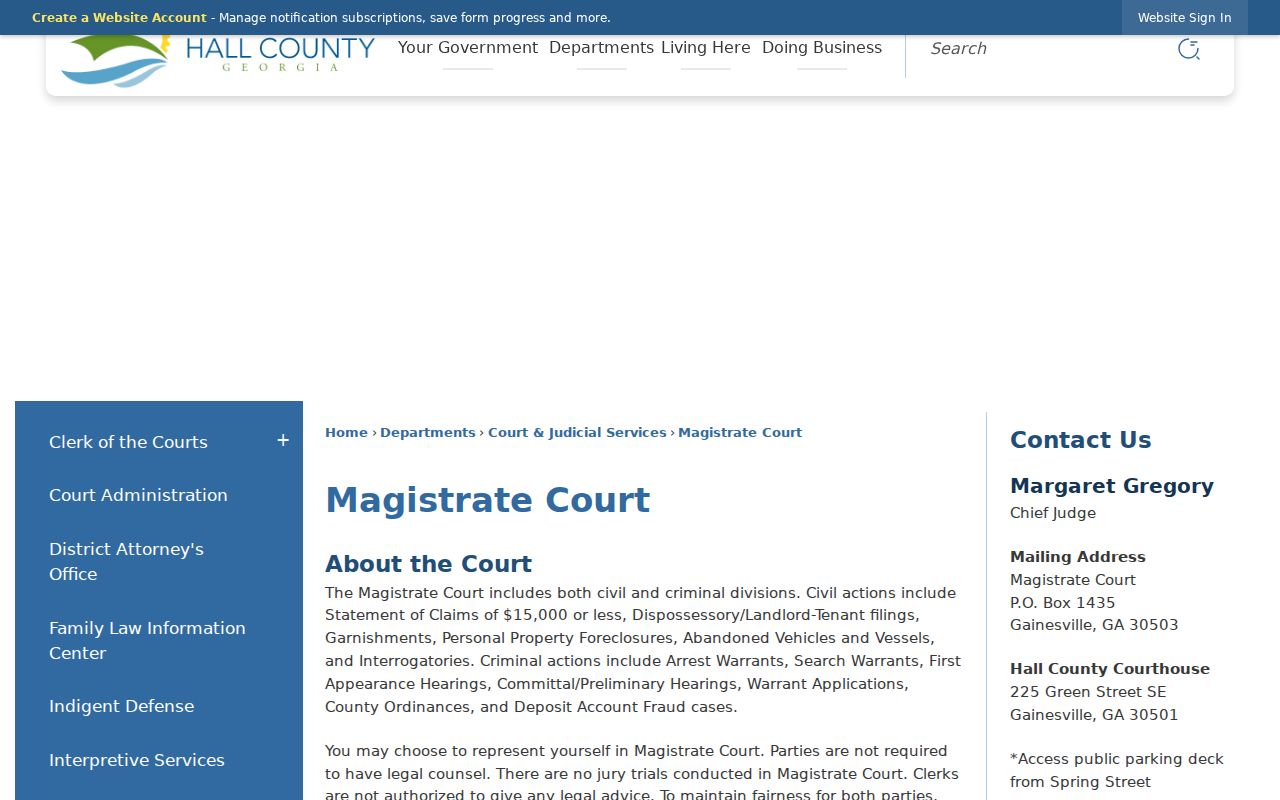
Nothing on it offers online filing or an online warrant query. Ask the Hall County clerk about hours, identification, accepted payment, and whether a scheduled appearance is required before you travel to the courthouse.
Hall County Warrant Volume in Context
Aggregate numbers show the system's shape without saying anything about a person. Hall County's budget materials report Magistrate Court workload year by year. Those figures are large. They explain why a single warrant record can pass through a court, a service unit, a jail, and a records desk before anyone asks about it.
Hall County's warrant numbers tell a story of heavy volume. Magistrates signed 8,414 warrants in 2023, then 7,439 in 2024, while criminal case filings held in the low hundreds both years. The jail side is just as busy. Roughly 600 arrest warrants get served every month, and the complex holds 1,026 main beds plus 148 work-release beds, with house arrest for up to 60 people a day. The county's FY2026 budget guide is the source for those counts. It also covers a Hall County area near 393 square miles and a 2023 population estimate of 217,267. One more change may be coming: the county has described a planned building attached to the jail for records, warrants, and state criminal-information work, so the public counter could move. None of these figures shows that any named person is wanted; they measure court and jail activity only.
If You Have a Warrant in Hall County
Fixing a Hall County warrant starts with the court that signed it. Only a judge can recall one. Paying money rarely ends the matter by itself. Your realistic options are hiring a lawyer, arranging a lawful surrender ahead of time, posting bond at the jail, or getting a court order that recalls or quashes the warrant. The jail takes bonds only after booking and identification are done, and the Sheriff charges a $20 non-refundable bond fee per criminal charge, cash only and in the exact amount. Whether the warrant lifts is the judge's call. The clerk can tell you what that judge requires. A lawyer who has read the actual file remains the best advice.
- Talk to a lawyer before you travel to any counter or pay anyone.
- Call the court named on the paperwork and ask what its order requires now.
- Ask the warrant deputies what lawful surrender process applies, since no public walk-in hours are published.
- Ask which bond route fits the charge, and what the counter accepts.
- Keep every receipt, release, and disposition, because a payment record is not a recall order.
Bond paperwork varies by route. A property bond calls for an original or certified deed, a current paid mortgage statement, and every deed party present with government photo identification, plus a certified death certificate if a deed party has died. Only one property bond is allowed at a time. A cash bond needs the full amount, fees included, in cash. A professional bondsman is another option, though the Sheriff does not recommend companies in Hall County.
Important: An active Hall County warrant can lead to arrest at a routine traffic stop, so get legal advice before traveling to any courthouse or jail counter.
Note: Ask the Hall County court to confirm in writing that the warrant was recalled, and keep the written or electronic release it issues.
Hall County Bench Warrants and DDS Holds
A bench warrant is an arrest order a judge signs when someone skips a required court date. In Hall County that missed obligation is often a traffic appearance or an unresolved citation. The county's traffic materials spell out the cost plainly: an added $72.50 fee, a possible license suspension, and a bench warrant, all under O.C.G.A. §17-7-90. Georgia's uniform citation rules let a court accept a sufficient excuse for the absence. Some courts mail a warning notice before a warrant issues, but no rule requires it. From there the court track and the driver-license track run side by side. They are connected. They are not the same record.
Typical sequence: missed setting › failure-to-appear entry › bench warrant signed › license notice sent › suspension › court release › reinstatement
Georgia's Department of Driver Services says a suspension can start 28 calendar days after it receives the court's notice. To fix it, a driver must resolve the court matter, get the court's written or electronic release, and then meet reinstatement requirements. The DDS failure-to-appear explanation covers only the license side. A clean license does not prove a warrant was recalled. A recall does not restore driving on its own either. For the court half of that sequence, the Hall County bench warrant search routes go deeper.
Hall County Warrant Scam Warnings
Warrant talk is a phone scammer's favorite script, and Hall County has put out two pointed warnings. In March 2025 the Sheriff said neither the Sheriff's Office nor Pretrial Services ever calls to solicit bond money, and that bonds are handled at the Hall County Jail, never through a payment app. In July 2025 the county flagged a jury-duty scam in which callers claimed a missed summons had produced a warrant and demanded prepaid cards. The tell is always the same. Urgency, an arrest threat, and a payment method you cannot reverse. Real Hall County offices do not operate that way.
- End the call rather than answering questions or confirming details.
- Find the court or Sheriff number yourself instead of calling back the number that called you.
- Treat any demand for gift cards, crypto, wire transfers, or app payments as a scam.
- Use the Sheriff's non-emergency dispatch line at 770-536-8812 for a non-urgent safety question, and 911 only for an emergency.
Note: A Hall County caller threatening arrest and demanding payment is no substitute for the court's own published phone number.
Hall County Warrant Records and Public Access
Georgia begins with broad public access to government records and then narrows it with exceptions. So a request for Hall County warrant records can bring back a partial file, a complete one, or a flat refusal. A custodian may redact personal identifiers, withhold material tied to an active investigation, protect juvenile information, or say the compilation you want simply is not maintained. Sealed court material sits outside the public track altogether. The fair expectation is the segregable non-exempt parts, with a stated reason for whatever is held back. Investigative sensitivity is a genuine limit, not a dodge. A Hall County custodian should name the basis it relies on.
Key Rules:
O.C.G.A. §17-4-40 sets who may issue an arrest warrant in Georgia and requires probable cause from personal knowledge or sworn information.
O.C.G.A. §§50-18-70 through 50-18-77 is the Georgia Open Records Act, and it governs how a request is made, what fees apply, and which exemptions allow withholding or redaction.
O.C.G.A. §15-11-701 keeps juvenile records confidential, so the adult docket is never a complete picture for anyone under 18.
Two practical limits follow. An agency in Hall County need not build a new report or database it does not already keep, and it need not answer a legal question in place of producing a record. Ask for the document itself.
Requesting Hall County Warrant Records
Hall County splits its warrant records requests by custodian. There is no single door. Sheriff requests go to the Sheriff's Records Supervisor, Lieutenant Cameron Parker, at 2859 Browns Bridge Road in Gainesville, and the county treats a request as unfiled until it reaches that custodian. Call 770-531-6877 with questions. Court warrant records sit with the clerk of court. Beginning July 1, 2026, most other county departments move to Hall County's NextRequest portal, though the Sheriff and the courts stay outside it. So routing matters as much as wording. Timing follows Georgia's familiar pattern. Hall answers within three business days when the records are readily available, and longer when retrieval, review, or redaction is needed. Fees stay modest. The first 15 minutes of staff time are free. After that, the lowest-skilled qualified employee's hourly rate applies. Copies run $0.10 per page, with a certification charge for certified pages. One more wrinkle: the NextRequest portal notes that an anonymous request cannot receive updates, so include a contact address if you want a status reply.
- Name the custodian, either the Sheriff's Office or the specific court and clerk.
- Name the record: a warrant, a service return, a recall or quash order, an FTA docket entry, a bond record, or a disposition.
- Give a narrow date range plus the issuing court, incident date, or document title if you know them.
- Ask for electronic delivery and an itemized fee estimate before work passes a threshold you set.
- Ask the custodian to state in writing that no responsive record is maintained, rather than asking anyone to build a list.
Hall County's Sheriff's open records instructions carry the custodian, fee, and timing rules. The countywide page shows how routing works.
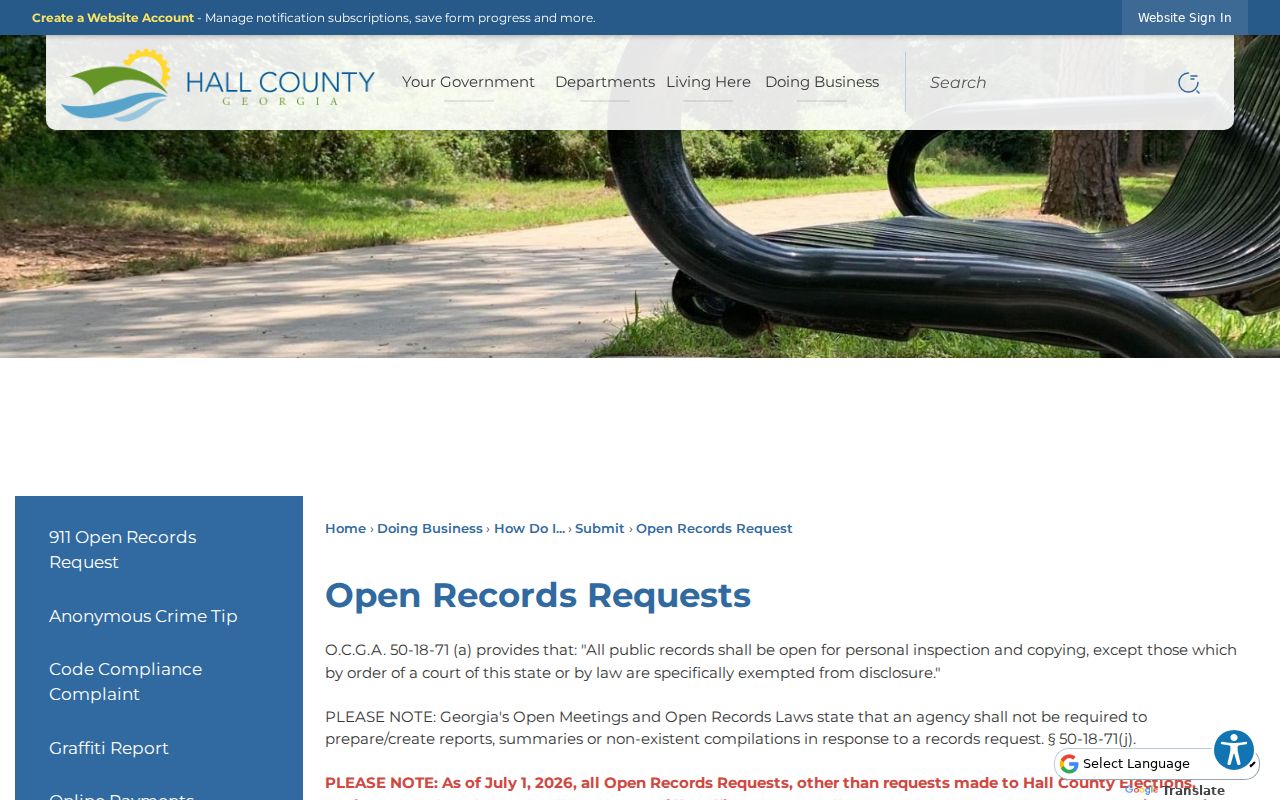
The split is the point. Hall County's general portal is not the Sheriff's channel. It is not the clerk's channel either. A warrant request sent to the wrong desk just restarts the clock. Note: Ask for the status as of a stated date and the custodian's source system, so a later copy can be compared against the same field.
Hall County Warrants by City
City police make the arrests. City municipal courts issue their own warrants for traffic, ordinance, and failure-to-appear matters. Those city warrants never appear on a Hall County list. No county list exists, and the city clerk holds the case. A resident checking a city citation starts with the court named on the paper. The county matters only if the paperwork points there. The five cities below are Hall County's largest by the 2020 Census. Each publishes a different route.
Gainesville Warrant Records
42,296 residents · Municipal Court on Queen City Parkway, plus a police Warrant Unit
Braselton Warrant Records
13,403 residents across four counties · Municipal Court and police share one building
Flowery Branch Warrant Records
9,391 residents · police and court administration answer one contact line
Oakwood Warrant Records
4,822 residents · Court Services sits at City Hall and court begins at 5 p.m.
Lula Warrant Records
2,822 residents · City Hall confirms which court and which county hold the file
Gainesville, the county seat, publishes the fullest instructions. It even offers a one-time courtesy reset if you contact the court at least three days before a setting. Oakwood is stricter. A continuance there must be requested in court. The city takes no payments by phone. Braselton allows a one-time continuance for good cause on at least one business day of notice. Flowery Branch routes continuance questions through police and court administration. Lula's published pages show no court or warrant route. City Hall is the practical starting point there. These gaps are why one county-wide instruction would mislead. Braselton's town limits also stretch into three counties beyond Hall, so a citation issued there may belong to a court outside Hall County entirely. Anyone under 17 in Gainesville goes to Hall County Juvenile Court instead of the municipal court. Those are jurisdiction facts, not preferences. Use the city's own published rule and confirm it with the clerk who answers the phone.